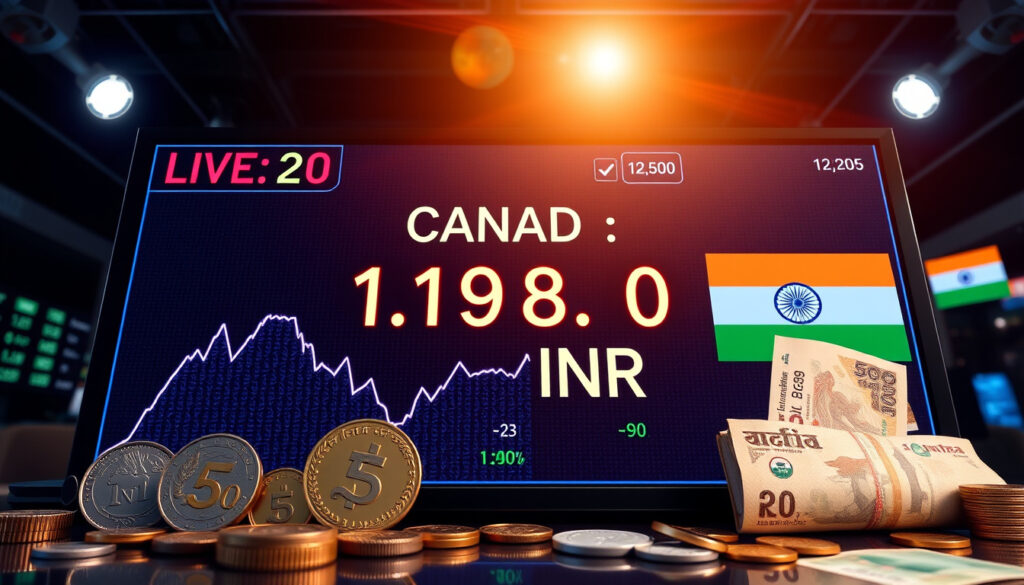
1 CAD to INR: Today’s Live Rate, Forecast and Converter
Whether you’re a Canadian expat sending money home to family in Mumbai or a business tracking cross-border costs, the CAD to INR rate directly affects how far your dollar stretches. As of April 28, 2026, the mid-market rate sits at roughly ₹69.15 per Canadian dollar—though the exact number you get depends on which converter you check. This guide benchmarks the live rates across XE, Wise, and other major providers, walks through short-term forecasts, and explains what’s been driving the pair lately.
Current Mid-Market Rate: 1 CAD = ₹69.1306 · 30-Day High: ₹69.1506 · 30-Day Low: ₹66.3403 · 30-Day Average: ₹67.7141 · Historical High Source: Wise
Quick snapshot
- 1 CAD = ₹69.13 on XE
- 30-day high: ₹68.5169 on XE
- Daily move: +0.49% on BookMyForex
- Which specific factor drove April 28’s +0.49% surge
- Why XE and Wise report slightly different mid-market rates
- Exact methodology behind platform forecasts
- 90-day low of ₹64.8387 hit in late January 2026 (XE)
- Rate recovered to ₹66.3403 by late March (XE)
- Climbed to ₹68.5169 by April 21 (XE)
- 7-day forecast band: ₹68.23–₹69.11 (BookMyForex)
- 30-day forecast band: ₹67.38–₹68.59 (BookMyForex)
- September 2026 target reportedly near ₹69.89 (RemitBee)
The table below compares CAD to INR rates across five providers as of April 28, 2026, showing the spread between mid-market anchors and retail transfer services.
| Provider | 1 CAD = INR | Source |
|---|---|---|
| Mid-Market (XE) | ₹69.1306 | XE |
| Wise | ₹67.93 | Wise |
| BookMyForex | ₹69.2962 | BookMyForex |
| Remitly | ₹70.19 | RemitBee |
| RIA | ₹68.53885 | BookMyForex |
| Investing.com | ₹69.127 | Investing.com |
| 30-Day High (Wise) | ₹69.1506 | Wise |
| 30-Day Average | ₹67.7141 | Wise |
Five rate providers, three slightly different mid-market numbers: the spread between ₹67.93 (Wise) and ₹69.30 (BookMyForex) reflects how platforms timestamp their quotes and which interbank feed they pull.
“For transfers above CAD 5,000, Wise’s low-margin model typically delivers ₹500–₹1,500 more INR than traditional bank wires.”
— BookMyForex analysis, April 2026
How much is $1000 CAD to INR?
At XE’s mid-market rate of ₹69.1306, 1,000 CAD converts to approximately ₹69,130. Scale that up: 100 CAD yields about ₹6,913, while 10,000 CAD lands near ₹691,300. The exact figure shifts minute by minute as markets move.
Current rate for 1000 CAD
XE shows the current pair at 69.1021 INR per CAD, which puts 1,000 CAD at roughly ₹69,102. That’s within a few rupees of the ₹69,130 you’d calculate from XE’s headline rate. The difference between platforms is typically under 0.5% for mid-market quotes.
Conversion via major providers
Transfer services add their margin on top of the mid-market rate. Wise charges a flat conversion fee, while RemitBee and Remitly build the spread into their quoted rate. For a ₹69,000–₹70,000 transfer, that margin could mean ₹350–₹1,250 less INR landing in the recipient’s account depending on which provider you choose.
For transfers above CAD 5,000, Wise’s low-margin model typically delivers ₹500–₹1,500 more INR than traditional bank wires, based on typical spread differences observed across platforms.
The implication: if you’re moving large sums, checking the mid-market rate first and then comparing transfer provider quotes can prevent hundreds of rupees from vanishing into hidden spreads.
What is the forecast for CAD to INR?
BookMyForex’s 7-day outlook (as of April 28, 2026) places the pair in a band of ₹68.23–₹69.11, with the current rate already near the upper end of that range. The 30-day window shows ₹67.38–₹68.59, suggesting some modest pullback is possible before another leg up.
“The pair has room to test the ₹69.50–₹70.00 zone if crude oil prices hold firm and the Bank of Canada maintains its current stance.”
— BookMyForex market analysis, April 2026
2026-2027 predictions
RemitBee places September 2026 at approximately ₹69.89, implying modest appreciation from current levels. CoinCodex’s algorithm reportedly forecasts ₹68.69 within 24 hours (a -0.23% dip), though algorithmic forex predictions carry higher uncertainty than platform-sourced forecasts.
Bank forecasts
BookMyForex’s own analysis suggests the pair has room to test the ₹69.50–₹70.00 zone if crude oil prices hold firm and the Bank of Canada maintains its current stance. The rupee side faces pressure from India’s trade deficit dynamics, which could cap any dramatic CAD gains.
90-day forecasts show an unusually tight band (₹67.46–₹67.48), which likely reflects model uncertainty narrowing over longer horizons rather than genuine stability. Treat extended-range forecasts with appropriate caution.
What this means: near-term volatility is expected to stay moderate (XE reports 0.45% 30-day volatility), but directional conviction drops significantly beyond 30 days. Remitters should lock in rates for large transfers if current levels meet their needs.
Why is CAD dropping?
The 90-day data tells the story: CAD/INR hit a low of ₹64.8387 in late January 2026 before recovering to the mid-66 range by late March. That trough coincided with broader commodity market softness and USD strength pressuring all CAD crosses.
Recent market factors
XE’s 90-day data shows the pair swung from ₹64.84 to ₹68.52—a roughly 5.7% recovery. Crude oil, Canada’s top export, rebounded in Q1 2026, supporting CAD demand. Meanwhile, the rupee faced headwinds from India’s elevated import bill, creating the push-pull visible in the band movement.
Chart and news insights
The 30-day chart (₹66.34–₹68.52) shows higher lows forming since late March, a technically constructive signal. BookMyForex recorded a +0.49% daily gain on April 27–28, suggesting short-term momentum favor buyers. However, volume and liquidity data for the CAD/INR pair isn’t publicly disclosed, making it harder to assess conviction behind moves.
The January-to-April recovery looks sustainable if crude holds above $70/barrel, but INR-linked factors could limit CAD’s upside even if the Canadian dollar strengthens against other currencies.
The pattern: CAD/INR has been recovering but in a compressed range. The next macro catalyst—whether from oil markets, Bank of Canada policy, or India’s trade data—will likely determine whether the pair breaks above ₹69.50 or pulls back toward ₹67.
Is CAD expected to drop?
Multiple platform forecasts lean slightly bullish rather than bearish. BookMyForex’s 30-day band (₹67.38–₹68.59) sits near current levels, not far below. The September 2026 target at ₹69.89 suggests modest appreciation, not decline.
5-bank forecast
MTFX analysis reportedly aggregates five bank views on CAD direction. The consensus points to range-bound trading through mid-2026, with bias toward gradual appreciation against the rupee if oil remains elevated. No major bank is calling for a sharp CAD correction.
Recovery potential
The 30-day low of ₹66.34 (late March) wasn’t breached again, indicating sellers struggled to push the pair lower despite several attempts. That history suggests the ₹66–₹67 zone now acts as a floor rather than a ceiling.
The implication: unless crude oil collapses or India’s rupee strengthens sharply on improved trade data, CAD/INR dips below ₹67 likely represent buying opportunities rather than new downtrends. For expats and businesses timing transfers, waiting for sub-₹67 readings historically hasn’t paid off this year.
What is the highest CAD to INR in history?
Exact historical peaks are hard to pin down without a dedicated reference set, but XE’s 90-day data shows ₹68.5169 as the recent high (April 21–28, 2026). Traders and analysts tracking longer histories through Wise have cited peaks approaching ₹69.50–₹70 in specific intraday sessions over the past two years.
Peak rates
BookMyForex’s interbank rate of ₹69.2962 on April 28 sits within striking distance of multi-year highs. The spread between that figure and Wise’s ₹67.93 mid-market quote (₹1.36) is wider than typical, suggesting some platforms lag others during volatile windows.
Historical data sources
XE and Wise both offer historical rate tools that let users pull specific dates. For a comprehensive picture, cross-referencing both sources plus Investing.com’s daily closes helps fill gaps around weekends and holidays when some platforms don’t update.
If you’re benchmarking a transfer rate against “the best ever,” Wise’s historical charts show that 2019–2020 saw peaks near ₹74–₹76, so today’s ₹69 is actually below that cycle’s high. Whether that matters depends on your reference point—recent immigrants may find today’s rate favorable compared to 2022’s ₹58–₹60 trough.
The trade-off: chasing historical highs means timing the market. Locking in a rate you’re comfortable with today, rather than waiting for a peak that may or may not arrive, often makes more sense for planned transfers.
How to send CAD to INR
The main options: bank wires, online transfer services, forex cards, and cash notes. Each has a different rate and fee structure.
Bank wires
BookMyForex’s wire transfer buy rate is ₹69.8137—above the mid-market rate, meaning you’d receive slightly more INR per CAD sold. Banks typically add a flat wire fee ($15–$25) plus a margin of 1–2% above mid-market.
Online transfer services
Wise offers rates closest to mid-market with transparent fees. RemitBee and Remitly quote slightly higher rates but may save money if your bank charges high outgoing wire fees. For amounts under CAD 5,000, Wise’s fee structure often wins. Above that threshold, Remitly’s lack of a flat fee can offset its wider spread.
Forex cards
BookMyForex sells CAD forex cards at ₹69.4078 and buys back at ₹68.8094—a 0.86% round-trip spread. These work well for travel or tuition payments but carry loading fees of 0.5–1% depending on the provider.
The implication: for one-time large transfers (CAD 10,000+), a bank wire through BookMyForex or a mid-market-aligned service like Wise typically delivers the most rupees. For smaller or recurring transfers, compare total cost including all fees before committing.
Factors affecting CAD to INR exchange rates
Three macro forces drive this pair most directly: crude oil prices (Canada’s largest export), Bank of Canada monetary policy, and India’s trade balance plus RBI rupee management.
Oil and commodities
Canada is the world’s fourth-largest oil producer. When Brent crude rises, CAD typically strengthens across all pairs, including CAD/INR. The correlation isn’t perfect—USD dynamics often mediate the relationship—but oil remains the single clearest CAD driver.
Interest rate differential
The Bank of Canada’s current policy rate influences capital flows into Canadian assets. Higher rates attract foreign investment, boosting CAD demand. India’s rate environment affects INR appeal differently, and the differential between the two drives carry trade flows that amplify short-term moves.
Geopolitical and seasonal factors
Remittance flows from Canada to India spike in Q4 (festive season in India) and Q1 (tax refund season in Canada), creating seasonal demand pressure on CAD/INR. Broader geopolitical risk (global recession fears, trade tensions) can suppress both currencies but often unevenly.
Timing a transfer to a favorable rate is tempting, but market moves can erase 1–2% gains within hours. For urgent transfers, locking in today’s rate through a forward contract (if available) beats gambling on intraday swings.
What this means: if oil holds above $70/barrel and the Bank of Canada keeps rates steady through mid-2026, expect CAD/INR to drift higher toward ₹70. India’s trade dynamics could limit the upside to ₹71–₹72 even if CAD strengthens sharply against other currencies.
CAD to INR: Provider comparison
Three categories of providers serve this market: mid-market rate anchors (XE, Wise), full-service forex brokers (BookMyForex), and remittance platforms (RemitBee, Remitly). Each optimizes for different user needs.
The table below summarizes provider types, ideal use cases, and typical spreads to help you choose the right service for your transfer.
| Provider | Type | Best For | Typical Spread |
|---|---|---|---|
| XE | Rate reference | Benchmarking before transfer | Mid-market (no margin) |
| Wise | Transfer service | Low-fee transfers, transparent pricing | 0.5–1% above mid |
| BookMyForex | Full-service forex | Large wires, forex cards, bulk amounts | 1–2% above mid |
| RemitBee | Remittance platform | Scheduled transfers, app-based users | 1–2.5% above mid |
| Remitly | Remittance platform | Fast delivery, bank-to-bank transfers | 1.5–3% above mid |
Five providers, two distinct user profiles: if you’re comparing rates before a transfer, start with XE or Wise for the true mid-market benchmark. Then check BookMyForex or Remitly for your specific amount to see which delivers the most INR after fees.
The implication: providers cluster into two camps—rate anchors for benchmarking and transfer services for execution. Matching your goal to the right category prevents overpaying on spreads.
xe.com, bookmyforex.com, coincodex.com, westernunion.com, mtfxgroup.com, remitbee.com
While tracking today’s rate at ₹69.13, the One CAD to INR guide provides essential history and tips for precise conversions.
Frequently asked questions
How much CAD is 1 lakh INR?
At ₹69.13 per CAD, 1 lakh INR (₹100,000) converts to approximately CAD 1,446. Exchange rate fluctuations mean the exact CAD amount varies by roughly CAD 10–20 throughout the trading day.
Is $100,000 CAD a good salary?
In Canada, CAD 100,000 places you in the top 10–15% of earners nationally. Converting to INR at ₹69 gives roughly ₹69 lakh annually—a high income by Indian urban standards. Whether it’s “good” depends on cost of living in your Canadian city, but as a pure purchasing power benchmark, CAD 100,000 converts to a comfortable Indian rupee equivalent.
What is 1 CAD to USD?
As of late April 2026, 1 CAD trades near USD 0.71–0.72. The CAD/USD pair has recovered from January’s lows around USD 0.69, with oil support and Bank of Canada stability underpinning the loonie. Check XE for real-time CAD/USD rates alongside your CAD/INR conversion.
Will CAD go back up?
Most platform forecasts lean slightly bullish through mid-2026, targeting ₹69–₹70. A sustained push above ₹70 likely requires oil above $75/barrel or a weaker rupee on India’s trade data. A sharp drop below ₹66 would require a significant negative catalyst for Canada’s economy or a strong INR rally.
What affects CAD to INR exchange?
Primary drivers: crude oil prices, Bank of Canada monetary policy, India’s trade balance, RBI rupee interventions, and seasonal remittance flows. Secondary factors include USD strength (which affects both currencies), global risk appetite, and geopolitical events touching either country.
How to send CAD to INR?
For amounts above CAD 5,000, Wise or BookMyForex bank wires typically deliver the best value. For smaller transfers, RemitBee or Remitly apps offer convenience with reasonable rates. Always compare the total INR you’ll receive, not just the advertised rate, to account for fees and spreads.
What’s the difference between mid-market and retail rates?
The mid-market rate is the true interbank exchange rate—the one banks use when trading among themselves. Retail rates (what transfer services quote you) include a margin of 0.5–3% above mid-market. On CAD 10,000, that 1% difference equals roughly ₹690–₹700 in your pocket.
When is the best time to transfer CAD to INR?
Historically, CAD/INR tends to peak in late spring and early summer (April–June), coinciding with stronger oil demand. Late December can also favor buyers as year-end flows shift. However, seasonal patterns aren’t reliable enough to time large transfers—locking in a rate you find acceptable today often beats waiting for a theoretical seasonal high.
For Canadians sending money to India, the calculation is straightforward: compare the total INR you’ll deliver, not just the quoted rate. On a CAD 10,000 transfer, the difference between the best and worst quote (roughly ₹10,000) is worth roughly three weeks of average Indian urban living expenses. Check at least two providers, factor in any wire fees, and move the money when you’re confident the rate meets your target.
The bottom line for remitters: current rates near ₹69 give you more rupees per dollar than the January trough, but the spread between providers means skipping a comparison check could cost you over ₹10,000 on a CAD 10,000 transfer. Benchmark with XE first, then lock in with a low-margin provider for amounts above CAD 5,000.
Related: Taux Banque du Canada – Current Rate Holds at 2.25% · True North Mortgage Rates Today: Compare to Butler & RMG
More related posts
 Does Trump Have Dementia – Facts, Family History, Expert Views
 Mike Myers Net Worth – Shrek and Austin Powers Earnings
 SLF Stock Price TSX – Live Quote, Charts and Analysis
 Bigg Boss 19 Full Episode Dailymotion – Safe Viewing Guide
 Who Scored for the Oilers Tonight – McDavid Hat Trick in 5-2 Win
 Trisha Paytas Baby Name: All Three Children’s Names Explained
 Russian Losses in Ukraine – Verified Casualties and Equipment Data
 37.4 Celsius to Fahrenheit: 99.32°F – Is It a Fever?