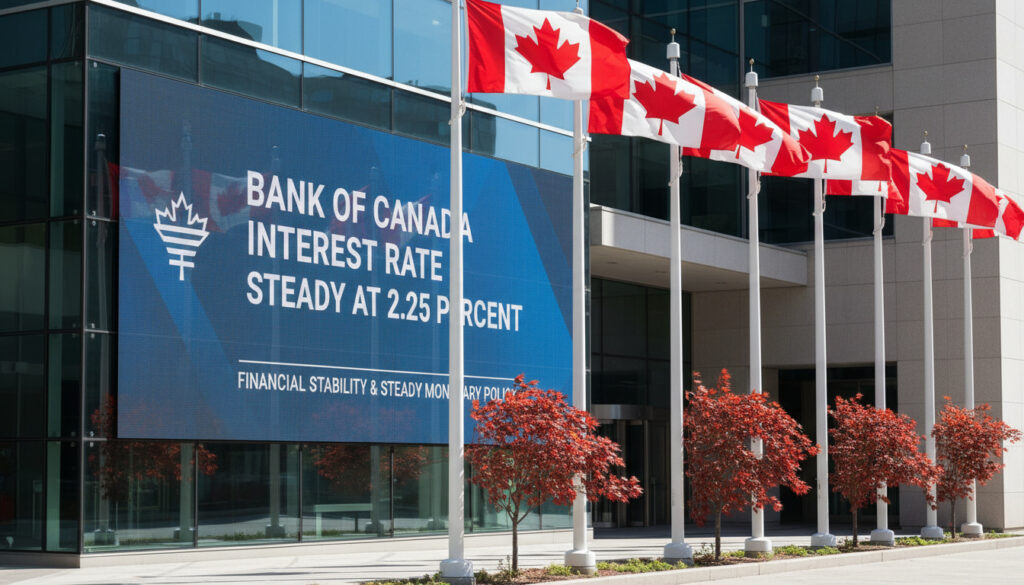
Taux Banque du Canada – Current Rate Holds at 2.25%
The Bank of Canada maintains its key policy interest rate at 2.25%, holding the taux directeur steady through March 2026 following a sustained reduction cycle that began from higher levels in 2024. This benchmark—formally the target for the overnight rate—serves as the foundation for Canadian monetary policy, directly influencing lending rates across mortgages, business loans, and consumer credit.
After reaching a peak of 4.75% in June 2024, the central bank executed consecutive reductions totaling 250 basis points over eighteen months, bringing borrowing costs down to support economic growth that remains below long-term potential. Official data confirms the rate has remained static since the October 29, 2025 adjustment.
The current stance reflects a balancing act: domestic GDP grew 2.6% in the third quarter of 2025 and labor markets show resilience, yet officials monitor external risks that could necessitate future adjustments. The operating framework employs a 50-basis-point band, with the Bank Rate at 2.50% and the deposit rate at 2.20%.
What is the Current Bank of Canada Interest Rate?
2.25%
Oct 29, 2025
(-25 bps)
On Hold
2.20% – 2.50%
- The 2.25% policy rate sits significantly below the long-term historical average of 5.75% recorded since 1990.
- Changes to the overnight target transmit to bank prime rates within days, affecting variable mortgages and lines of credit.
- The current level represents a 250-basis-point reduction from the June 2024 peak of 4.75%.
- Currency markets respond to interest rate differentials, though specific comparisons to the US Federal Reserve remain context-dependent.
- The Bank Rate (2.50%) and deposit rate (2.20%) create the 50-basis-point corridor within which overnight funding fluctuates.
- Fixed announcement dates provide transparency, with decisions scheduled eight times annually.
| Indicator | Current Value | Period | Source |
|---|---|---|---|
| Overnight Target Rate | 2.25% | March 2026 | Official Bank of Canada release |
| Bank Rate (Ceiling) | 2.50% | March 2026 | Policy implementation framework |
| Deposit Rate (Floor) | 2.20% | March 2026 | Operational guidelines |
| Historical Average | 5.75% | 1990–2026 | YCharts historical data |
| Record High | 16.00% | 1991 | Trading Economics historical records |
| Crisis Low | 0.25% | 2009 | Trading Economics historical records |
| Recent GDP Growth | 2.6% | Q3 2025 | National accounts data |
When is the Next Bank of Canada Rate Decision?
The central bank operates on a fixed announcement schedule comprising eight predetermined dates annually, a system initiated in December 2000 to enhance transparency. The official schedule lists all upcoming decision dates, eliminating uncertainty about announcement timing.
Decisions typically post at 10:00 a.m. Eastern Time, followed by a press conference where the Governor explains the policy rationale. The March 18, 2026 meeting concluded with no change to the 2.25% target, maintaining the stance established in late 2025.
Unlike previous eras of unscheduled announcements, the current eight-date system allows mortgage professionals and corporate treasurers to plan rate-sensitive transactions around specific decision windows, reducing market volatility.
What is the History of Bank of Canada Rates?
Evolution of the Policy Framework
Historical documentation shows the Bank shifted emphasis to the overnight rate target in June 1994, establishing a 50-basis-point operating band. By February 1999, the target evolved to represent the midpoint of this band—precisely 25 basis points below the Bank Rate. Since May 2001, this overnight target has served as the primary policy lever, replacing previous operational targets.
The 2024–2026 Easing Cycle
The current period follows an aggressive tightening phase that saw the policy rate peak at 4.75% in June 2024. Between June 2024 and October 2025, the Bank executed consecutive reductions: 25 basis points in June, followed by similar cuts in July, September, October, and December 2024, then continuing into 2025 with reductions in January, March, September, and October.
By October 29, 2025, the rate reached 2.25%, where it has remained through the March 2026 decision point, marking four consecutive hold decisions.
How Does the Bank of Canada Set Interest Rates and What is Their Impact?
Transmission to Mortgages and Credit
The overnight target functions as the anchor for the Canadian financial system. When the Bank adjusts this rate, changes transmit rapidly to the prime lending rates of major chartered banks, directly affecting interest-sensitive securities and SLF Stock Price TSX – Live Quote, Charts and Analysis.
Variable-rate mortgage holders experience payment adjustments within one to three billing cycles following rate changes, while fixed-rate products respond more gradually based on bond market yields.
The Bank of Canada sets the target but allows the overnight rate to trade within a 50-basis-point corridor. The Bank Rate (ceiling) and deposit rate (floor) define this band, ensuring interbank lending stays within policy bounds without requiring daily intervention.
Economic Context and Forecast
Economic data indicates Canadian GDP grew 2.6% in the third quarter of 2025, while labor markets maintain strength. The Bank characterized the current 2.25% level as “appropriate” in March 2026, though officials noted potential for “bidirectional adjustments” should conditions shift.
Geopolitical volatility, particularly risks emanating from the Middle East, represent upside threats to inflation that could necessitate future tightening despite domestic growth running below trend.
While domestic indicators support the current hold policy, the Bank explicitly cites Middle East volatility as a material risk. External supply shocks could force policy adjustments independent of Canadian employment or output data.
Comparison with US Federal Reserve Policy
TD Economic analysis demonstrates that Canadian rates periodically diverge from the US federal funds rate, though the two typically move in broad alignment during major cycles. During the recent tightening phase, both central banks raised rates, though Canadian growth remained below trend throughout. The article also notes that the highest-paid NBA player in 2025-26 will be determined by various factors. jugador millor pagat de l’NBA 2025-26
Current Bank of Canada policy stands at 2.25%; specific comparable US rate data was not available in reviewed materials.
Timeline of Recent Bank of Canada Decisions
The following sequence tracks the last ten policy adjustments, illustrating the transition from tightening through the current holding pattern:
- : Rate cut to 4.75% (-0.25 pp)
- : Rate cut to 4.50% (-0.25 pp)
- : Rate cut to 4.25% (-0.25 pp)
- : Rate cut to 3.75% (-0.50 pp)
- : Rate cut to 3.25% (-0.50 pp)
- : Rate cut to 3.00% (-0.25 pp) — Global Rates data
- : Rate cut to 2.75% (-0.25 pp)
- : Rate cut to 2.50% (-0.25 pp)
- : Rate cut to 2.25% (-0.25 pp)
- : Rate held at 2.25%
Established Facts and Remaining Uncertainties
| Confirmed Information | Uncertain Developments |
|---|---|
| The overnight target holds at 2.25% as of March 2026. | Specific timing of future adjustments remains undefined; officials cite potential for “bidirectional” moves. |
| Fixed announcement dates occur eight times yearly on a published calendar. | Trajectories of Middle East geopolitical risks and their inflationary impact. |
| The operating band framework has guided policy since 1994/2001. | Exact future convergence or divergence with US Federal Reserve rates. |
| GDP grew 2.6% in Q3 2025; labor markets show sustained strength. | Long-term neutral rate level appropriate for post-pandemic economy. |
Why the Overnight Rate Matters
The taux directeur represents more than a single number—it serves as the economy’s primary thermostat. By adjusting the cost of overnight funds between financial institutions, the Bank of Canada influences every subsequent lending decision, from five-year fixed mortgages to commercial credit lines.
When the Bank maintains rates at 2.25%, it signals confidence that inflation will converge toward the 2% target without requiring restrictive policy, while remaining vigilant against external shocks. This stance supports household balance sheets after the stringent conditions of 2023-2024, yet preserves optionality to tighten should price pressures resurface.
Data Attribution and Methodology
This analysis draws exclusively on official Bank of Canada publications, market data providers, and economic research institutions. Key data points originate from the Bank of Canada’s official interest rate releases and historical records maintained by the Bank’s documentation team.
Market data including historical averages and daily rate tracking comes from YCharts and Trading Economics. Schedule information and recent decision chronology reference MyPerch tracking and Global Rates central bank data. Comparative analysis of US-Canada policy divergence relies on TD Economics research.
Key Takeaways on Canadian Monetary Policy
The Bank of Canada holds its key interest rate at 2.25% through March 2026, maintaining a steady stance after aggressive cuts from the 2024 peak. While the current level supports growth amid 2.6% GDP expansion, officials retain flexibility to adjust in either direction depending on inflation developments and global stability. Borrowers benefit from reduced carrying costs compared to 2024, though the trajectory of future relief remains uncertain. Investors seeking exposure to rate-sensitive sectors might consider reviewing Stocks to Buy Now – Top Zacks #1 Strong Buys alongside fixed-income allocations.
Frequently Asked Questions
What is the overnight target rate?
The overnight target rate, or taux directeur, is the Bank of Canada’s key policy interest rate that guides the cost of overnight borrowing between financial institutions. It serves as the anchor for the Canadian financial system.
How does the Bank of Canada rate compare to the US Federal Reserve rate?
While Canadian rates historically align broadly with US policy, periodic divergences occur based on domestic conditions. The current Bank of Canada rate is 2.25%; specific comparable US Fed rate data was not available in reviewed materials.
What is the Bank of Canada interest rate forecast?
As of March 2026, the Bank considers the 2.25% level “appropriate” but signals potential for bidirectional adjustments. No explicit forward guidance exists, with decisions dependent on inflation data and global risk factors.
How fast do Bank of Canada rate changes affect mortgage payments?
Variable-rate mortgages typically adjust within one to three billing cycles following a rate change. Fixed-rate mortgages respond more gradually, based on underlying bond yields rather than immediate policy shifts.
What is the difference between the Bank Rate and the overnight target?
The Bank Rate, currently 2.50%, marks the ceiling of the 50-basis-point operating band. The overnight target, at 2.25%, sits at the midpoint, while the deposit rate at 2.20% forms the floor.
Why did rates drop from 4.75% to 2.25% between 2024 and 2025?
The Bank implemented consecutive reductions to support economic growth running below trend, following an aggressive tightening cycle that peaked in mid-2024. This easing reduced borrowing costs as inflation pressures moderated.
More related posts
 When Is Earth Day 2025 – Date, Theme & Canada Events
 Dodgers vs Blue Jays 2025: World Series Game 7 & Records
 Who Scored for the Oilers Tonight – McDavid Hat Trick in 5-2 Win
 Dire Wolf Brought Back? Colossal’s De-Extinction Dispute
 Why Are Flags at Half Mast Today? Ireland, UK, US Updates
 How to Block Your Number on iPhone: Hide Caller ID 2 Ways
 Oilers News and Rumours – Playoff Race, Injuries and Cap Updates
 Guide to www.disquantified.org: Verified Facts and Questions