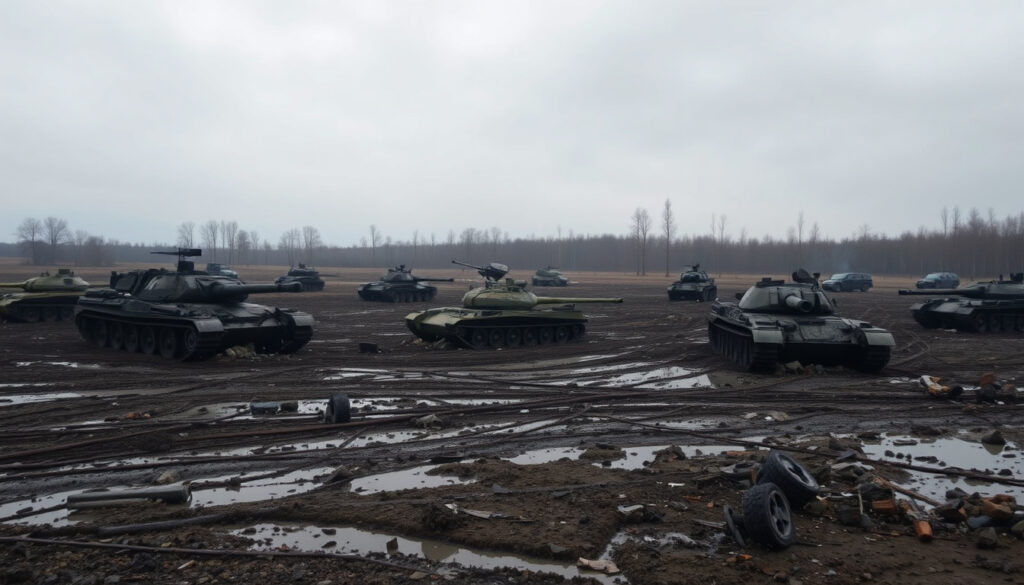
Russian Losses in Ukraine – Verified Casualties and Equipment Data
Since Russia’s full-scale invasion of Ukraine began on February 24, 2022, the conflict has produced staggering military losses on both sides. Tracking these figures requires examining multiple independent sources, as official claims often diverge significantly from verified counts. This analysis compiles the most reliable data available from open-source investigators, Western intelligence, and independent journalists to provide a comprehensive picture of Russian losses in Ukraine.
Western intelligence agencies and independent researchers have spent years documenting equipment destroyed, personnel casualties, and the broader toll of the fighting. The numbers vary widely depending on methodology, with some sources relying on visual confirmation while others aggregate official reports. Understanding these differences is essential for anyone seeking to grasp the true scale of attrition along the front lines.
How Many Russian Soldiers Have Been Killed in Ukraine?
Estimates of Russian personnel casualties span an enormous range, from conservative verified counts to figures reported by Ukrainian authorities. Western intelligence assessments place total Russian losses since the invasion at between 950,000 and 1.3 million, encompassing both killed and wounded personnel as of early 2026. This figure reflects the intensified fighting that characterized much of 2024, when daily casualty rates climbed substantially.
Key Insights from Casualty Data
- Named, verified deaths account for only a small fraction of total estimates, with the gap reflecting the difficulty of independent confirmation in active war zones
- Daily casualty rates fluctuated significantly throughout 2024 and 2025, ranging from approximately 930 to 1,570 Russian personnel killed or wounded per day
- Meduza estimated roughly 120,000 Russian soldiers killed through June 30, 2024, a figure that has grown substantially since
- UK Defence Intelligence reported 1.118 million total casualties as of October 14, 2025, including 332,000 since January 1 of that year
- CSIS analysis from 2024 indicated over 950,000 total casualties with 250,000 killed since January 2024 alone
- Early war deaths disproportionately affected soldiers aged 21–23 from regular army units, according to Mediazona data
- Global Defense Corp documented 6,710 senior officers and 45 top generals killed among Russian forces through late 2024
Personnel Casualty Comparison Table
| Category | Ukrainian Claims | Verified Count | Western Estimate |
|---|---|---|---|
| Total Casualties | ~1.3 million | 187,000+ (dated) | 950K–1.118M |
| Named Deaths | Not specified | 16,062–20,019 | N/A |
| Daily Rate (2024–25) | Higher than Western | Cannot verify daily | 1,000–1,570 |
| Officers Killed | Included in total | Partially verified | 6,710 senior |
How Accurate Are Ukrainian Claims of Russian Losses?
The Ukrainian General Staff publishes daily updates on Russian losses through the Ministry of Digital Transformation, with figures showing incremental increases across equipment categories. These reports claim over 404,000 total pieces of military equipment lost by Russia as of April 2026, with daily additions of tanks, armored vehicles, and artillery systems. However, these figures lack independent photo or video verification, raising questions about their accuracy.
The Role of Independent Verification
Organizations like Oryx have established methodologies requiring visual documentation before counting equipment as destroyed, captured, or damaged. This approach provides a verified baseline that is inherently lower than official claims but offers higher confidence in individual cases. According to the Oryx visual loss tracking, Russian equipment losses substantially exceed Ukrainian losses, with confirmed ratios favoring Ukraine by 2:1 to 5:1 since January 2024.
Oryx only counts equipment losses when photos or videos provide visual confirmation, making their figures conservative lower bounds rather than comprehensive totals. The gap between visually confirmed losses and total estimates reflects the practical limitations of documenting destruction in active combat zones.
Named Casualty Verification
Mediazona, in collaboration with BBC News Russian, has developed an independent methodology for verifying Russian military deaths by cross-referencing open-source reports with obituary notices, social media posts, and official records. Their count of 16,062 to 20,019 named deaths through February 11, 2026, represents the most rigorously documented figure available. As of March 27, 2026, Mediazona’s ongoing investigation confirmed dates of death for 187,000 cases, with probate registry estimates extending through August 2025.
What Are Russian Equipment Losses in Ukraine?
Russian equipment attrition has been substantial across all major categories, from main battle tanks to artillery systems and aircraft. The Ukrainian General Staff reports that Russia has lost between 11,847 and 11,848 tanks since the invasion began, with current daily rates adding approximately 1 to 4 vehicles per day. Armored fighting vehicles account for an additional 24,370 to 24,375 losses, while artillery systems represent the largest category at nearly 40,000 pieces.
Tank Losses by Model and Era
Analysis of documented losses reveals that Russia has deployed older model tanks, including T-55s from the Cold War era, alongside more modern T-72, T-80, and T-90 variants. Global Defense Corp documented 41 S-400 air defense systems destroyed as of November 2024, highlighting the vulnerability of Russia’s once-feared air defense network. Aircraft losses stand at 435 confirmed by the General Staff, with the rate of daily losses stabilizing in recent months.
Daily equipment losses reported by the General Staff show artillery systems accounting for the largest incremental increases, with 24 to 73 pieces destroyed or disabled per day in recent reports. Armored vehicles follow with 2 to 10 daily losses, while tank losses have slowed to 1 to 4 per day.
Air Domain Attrition
Russian aircraft losses have continued throughout the conflict despite Moscow’s efforts to maintain air superiority. The Oryx database documents substantial air domain losses, though the exact figures vary depending on verification standards. According to CSIS analysis, Russia has lost equipment at high rates relative to territorial gains achieved, suggesting significant logistical and tactical challenges in sustaining combat operations.
How Do Russian Losses Compare to Ukrainian Losses?
Western intelligence assessments consistently indicate that Russia has suffered higher absolute casualties than Ukraine, though the ratio varies depending on the time period and specific engagement. CSIS analysis from 2024 noted that Oryx-confirmed losses show Ukraine inflicting equipment attrition at ratios of 2:1 to 5:1 in Ukraine’s favor since January 2024. However, New York Times reporting from January 2025 suggested Russia has achieved approximately a 2:1 casualty advantage in personnel through more effective use of glide bombs and concentrated assaults.
Western Intelligence Perspectives
British Army Chief Sir Roland Walker forecast in July 2024 that Russia would need to sustain 1.5 to 1.8 million total casualties to control claimed regions at then-current fighting rates. UK Defence Intelligence data from October 2025 documented 1.118 million cumulative Russian casualties since the invasion, including 332,000 occurring in 2025 alone. These figures indicate that Russian losses continue to accumulate at rates that would have been considered unsustainable by pre-war standards.
Methodology Differences
Comparing losses across sources requires understanding their distinct methodologies. Ukrainian daily reports from the Ministry of Digital Transformation provide consistent tracking but lack independent verification. Western intelligence estimates synthesize multiple intelligence sources but are necessarily estimates rather than confirmed counts. Independent investigators like Oryx and Mediazona provide the most transparent methodologies but cannot capture the full scope of losses that remain unrecorded.
Timeline: Key Escalation Points in Russian Losses
Russian casualties have fluctuated throughout the conflict, with distinct periods of intensified fighting producing spikes in personnel and equipment losses.
- February–April 2022: Initial invasion phase produced heavy losses during failed advances on Kyiv and other northern cities, with early deaths concentrated among 21–23-year-old regular army soldiers
- September 2022: Ukrainian counteroffensive in Kharkiv oblast produced a dramatic surge in documented Russian equipment losses, with Oryx documenting ratios reaching approximately 4:1 in Ukraine’s favor
- May–June 2024: NATO and Western officials estimated approximately 1,200 Russian casualties per day during intensified fighting
- December 2024: UK Defence Intelligence recorded peak daily rates of 1,570 Russian personnel killed or wounded, the highest documented rate
- August 2025: Daily casualty rates dropped to approximately 930, before rising above 1,000 again by October 2025
- January 2025–March 2026: UK Defence Intelligence documented 332,000 casualties in 2025, with Mediazona confirming dates of death for over 187,000 cases
What Is Known and What Remains Unclear
The available data on Russian losses presents a complex picture, with significant gaps between what can be verified and what remains estimated. Separating established facts from ongoing uncertainties helps contextualize casualty figures.
| Established Information | Information That Remains Unclear |
|---|---|
| Oryx has visually confirmed over 1,865 tank losses since January 2024 | Exact proportion of killed versus wounded in total casualty estimates |
| Mediazona verified 187,000+ dated death cases through March 2026 | Total Russian losses in occupied Ukrainian territories since 2014 |
| Equipment ratios favor Ukraine 2:1 to 5:1 since January 2024 | True number of Wagner Group and other PMC losses |
| Daily casualty rates ranged from 930 to 1,570 in 2024–2025 | How many casualties go unreported due to battlefield conditions |
| 41 S-400 systems confirmed destroyed by November 2024 | Current status of damaged but repairable equipment |
Data lags of several weeks or months are common when verifying recent losses. Open-source investigators require time to locate, document, and publish visual evidence, meaning current figures always underestimate recent activity.
Broader Context of Russian Attrition
The scale of Russian losses has reshaped both the military situation on the ground and discussions about the long-term sustainability of Moscow’s war effort. Despite controlling substantial Ukrainian territory, Russia has paid a price far exceeding what many pre-war analysts predicted. The persistent depletion of equipment and personnel is profoundly affecting the structure and composition of the Russian military.
Independent military analysts note that Russia has increasingly relied on older equipment stocks to sustain current operations, a pattern visible in the deployment of T-55 tanks and other Cold War-era systems. The loss of modern air defense assets like the S-400 has implications for Russia’s ability to protect rear areas and critical infrastructure from Ukrainian strikes.
The conflict has also produced significant officer casualties, with 6,710 senior officers and 45 top generals documented as killed through late 2024. These losses affect unit cohesion and command capacity, though Russia has demonstrated an ability to rotate forces and regenerate combat capability despite high attrition rates. The broader context of the Ukraine conflict reveals how attrition warfare has become a defining feature of modern large-scale ground operations.
Sources and Expert Assessments
Multiple organizations contribute to the tracking of Russian losses, each with distinct methodologies and strengths. The Mediazona investigation represents one of the most rigorous approaches to casualty verification, combining open-source monitoring with probate registry analysis to identify patterns in death documentation. Their work provides a verifiable foundation for understanding the human cost of the conflict.
The verified named deaths represent only a fraction of total losses, but they offer the most reliable indicator of actual trends when properly extrapolated.
— Mediazona/BBC News Russian cross-verification methodology
The Center for Strategic and International Studies has analyzed Russian battlefield performance, noting that despite territorial gains, equipment losses have occurred at rates that challenge long-term operational sustainability. CSIS reporting indicates that Russia has struggled to replace advanced systems at the same pace they are being destroyed or disabled.
Russia lost equipment at high rates despite modest gains, suggesting significant logistical and tactical challenges in sustaining combat operations.
— CSIS Battlefields Analysis, 2024
The UK government maintains regular updates through its official channels, providing Western intelligence perspectives on the conflict’s trajectory. These assessments, while necessarily imprecise, offer calibrated estimates based on multiple intelligence sources. Similarly, CSIS analysis and New York Times reporting provide additional Western perspectives on battlefield developments.
Summary
Russian losses in Ukraine since February 2022 represent one of the most extensively documented military attritions in modern warfare. Western intelligence estimates place total casualties between 950,000 and 1.3 million, while independent verification from Mediazona and BBC News Russian has confirmed over 187,000 dated death cases. Equipment losses exceed 400,000 pieces according to Ukrainian claims, with Oryx visually confirming substantial portions of tank and armored vehicle destruction at ratios favoring Ukraine 2:1 to 5:1.
Understanding these figures requires recognizing the methodological differences between sources. Daily reports from Ukrainian authorities provide consistent tracking but lack independent verification. Western intelligence offers calibrated estimates that acknowledge uncertainty. Independent investigators like Oryx and Mediazona provide the most transparent methodologies but necessarily capture only a portion of total losses. The gap between these approaches underscores the fundamental challenge of documenting warfare in real time.
For those seeking to understand the human and material cost of the conflict, examining multiple sources while recognizing their limitations offers the most balanced perspective. Data interpretation challenges extend beyond military analysis—similar methodological considerations apply across defense analytics, though the stakes differ enormously from armed conflict.
Frequently Asked Questions
What sources track Russian losses in Ukraine?
Multiple organizations track Russian losses using different methodologies. The Ukrainian General Staff provides daily updates through the Ministry of Digital Transformation. Independent researchers at Oryx document visually confirmed equipment losses. Mediazona, working with BBC News Russian, verifies named Russian military deaths through open-source monitoring and probate records. Western intelligence agencies including UK Defence Intelligence and US officials publish periodic assessments.
Are there confirmed names of Russian soldiers killed?
Yes, Mediazona and BBC News Russian have verified the identities of 16,062 to 20,019 Russian military personnel killed through February 2026. Their methodology involves cross-referencing open-source reports, obituaries, social media posts, and official records to confirm individual deaths with documented dates.
What are Western intelligence estimates of Russian casualties?
Western estimates place total Russian casualties between 950,000 and 1.118 million since the invasion began. UK Defence Intelligence reported 1.118 million cumulative casualties as of October 2025, including 332,000 occurring in 2025 alone. CSIS analysis from 2024 indicated over 950,000 total casualties with 250,000 killed since January 2024.
How many Russian tanks have been destroyed in Ukraine?
Ukrainian General Staff reports cite 11,847 to 11,848 tanks destroyed since the invasion began. However, Oryx visual documentation shows 1,865 tanks lost since January 2024 alone, indicating significant discrepancies between claimed and verified figures. The difference reflects the methodological requirements of visual confirmation.
How do verified losses compare to Ukrainian claims?
Verified losses from Oryx and other independent sources are substantially lower than Ukrainian claims, which often cite figures several times higher. This gap exists because independent verification requires visual documentation that cannot capture all losses. Ukrainian daily reports from the General Staff show tanks being added at 1 to 4 per day, while Oryx confirms only a portion of these.
What was the peak daily casualty rate for Russian forces?
UK Defence Intelligence recorded a peak of 1,570 Russian personnel killed or wounded per day in December 2024. Rates dropped to approximately 930 per day by August 2025 before rising above 1,000 again by October 2025. Earlier in 2024, NATO officials estimated rates around 1,200 per day during periods of intensified fighting.
How does equipment loss verification work?
Organizations like Oryx require photographic or video evidence before counting equipment as destroyed, damaged, or captured. This methodology provides high confidence in individual cases but necessarily undercounts total losses where documentation is unavailable. The gap between verified and total estimates reflects the practical limitations of battlefield documentation.
More related posts
 Best Waterproof Hiking Pants – Field-Tested Top Picks
 How to Reseed a Lawn – Step-by-Step Guide
 How to Write a Letter – Step-by-Step Guide to Formats
 Are Potatoes Gluten-Free? Celiac Facts on Risks & Safety
 Apply for Canadian Citizenship – Eligibility, Steps and 2025 Fees
 George Foreman Cause of Death: What Family and Reports Say
 Walk In Clinic Langley – Locations Hours Services Guide
 Classé Secret Saison 3: Release Date, Cast, Netflix Info