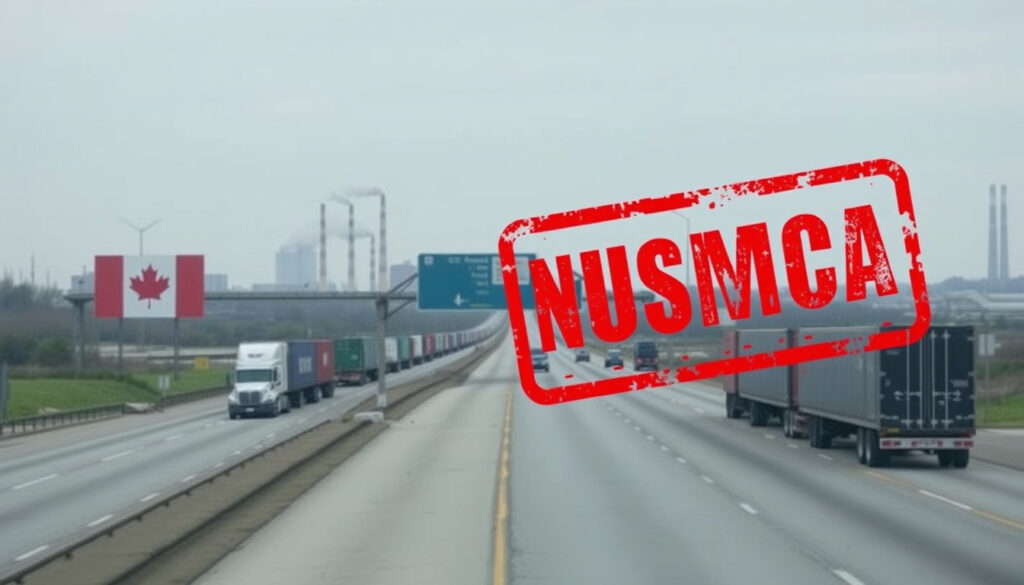
Trump’s Canada Trade War: Tariffs, USMCA and Impact
When the United States and Canada went through a trade war in 2025, it wasn’t just another tariff dispute — it was a test of a decades-old economic partnership. By March 2025, the U.S. had imposed 25% tariffs on most Canadian imports under the International Emergency Economic Powers Act (Wikipedia (open-source encyclopedia)), a move that rattled supply chains from the Great Lakes to the Pacific coast.
Tariff rate (most goods): 25% ·
Energy/potash tariff: 10% ·
USMCA-exempt trade: 85% ·
Canada exports to U.S.: 75% ·
Bilateral trade value: $900+ billion annually
Quick snapshot
- 25% tariff on most Canadian goods (Ivey Business School)
- 10% tariff on energy and potash (Blakes)
- Canada retaliated with 25% tariffs on U.S. goods (Econofact)
- Future negotiation timeline under USMCA (Econofact)
- Whether tariffs will escalate beyond 35% (The Fulcrum)
- Long-term impact on Canadian manufacturing (Ivey Business School)
- March 4, 2025: 25% tariffs imposed (Wikipedia)
- March 6, 2025: USMCA-compliant goods exempted (Wikipedia)
- August 1, 2025: Tariffs raised to 35% (Econofact)
- USC’s ability to impose broader tariffs under Trade Act of 1974 (Blakes)
- Canada diversifying trade partners (Wikipedia)
- Potential USMCA renegotiation in 2026 (Blakes)
Six key indicators, one pattern: the tariffs are broad but heavily riddled with exemptions that keep most cross-border trade flowing under USMCA.
| Metric | Value |
|---|---|
| Tariff rate (most goods) | 25% |
| Tariff rate (energy/potash) | 10% |
| Trade under USMCA exemption | 85% |
| Canada’s exports to U.S. | 75% of total |
| Date tariffs imposed | March 2025 |
| Total bilateral trade | $900+ billion annually |
What is Trump’s new trade agreement with Canada?
Overview of USMCA
The United States-Mexico-Canada Agreement (USMCA) replaced NAFTA on July 1, 2020 (Econofact). It preserved tariff-free access for goods that meet strict rules of origin, covering about 85% of Canada-U.S. trade by August 2025 (Wikipedia). The agreement was designed to modernize intellectual property, digital trade, and labor standards.
Trump’s tariffs and the trade war
Despite the USMCA, President Trump signed an executive order on February 1, 2025, imposing 25% tariffs on most Canadian goods under the International Emergency Economic Powers Act (The Fulcrum (nonprofit news outlet)). Canada retaliated within hours, imposing its own 25% tariffs on C$30 billion of U.S. imports (Blakes). The paradox: the USMCA remained in force, exempting USMCA-compliant goods, but the tariffs created deep uncertainty for sectors outside the deal – notably lumber and dairy.
The USMCA was supposed to be the final word on North American trade. Instead, Trump used IEEPA to bypass the agreement, citing a national emergency. That leaves Canadian exporters in a gray zone: they can route goods under USMCA rules to avoid tariffs, but the Trump administration has threatened 250–390% tariffs on products that don’t qualify.
The implication: The USMCA is now a safety net, not a shield. Companies must document origin carefully, or face steep penalties.
How much tariffs does Trump have on Canada?
25% tariffs on most goods
Effective March 4, 2025, the U.S. imposed 25% tariffs on all Canadian merchandise not covered by USMCA rules of origin (Wikipedia). On August 1, 2025, the rate was raised to 35% for all goods that remain outside USMCA compliance (Econofact (economic policy analysis)).
10% on energy and potash
Energy products – including crude oil, natural gas, and electricity – and potash receive a lower tariff rate of 10% (Wikipedia). This differential reflects the critical role of Canadian energy imports for U.S. refineries and agriculture.
Exemptions and timeline
On March 6, 2025, Trump exempted all USMCA-compliant goods from the tariffs (Wikipedia). As of August 2025, over 85% of Canada-U.S. trade remained tariff-free due to this exemption (Wikipedia). However, Canada’s retaliatory tariffs applied to non-USMCA U.S. goods, including autos (Econofact).
Canadian businesses that can prove USMCA origin pay zero tariffs. Those that cannot face 35% – a punishing spread that forces supply chains to reorganize or pass costs to consumers.
Why this matters: The effective tariff rate on Canada is not uniform. USMCA-compliant goods enjoy a free pass; others bear the full weight of the trade war. The pattern: the more integrated the product (like auto parts), the easier to qualify for exemption. Commodities like lumber and dairy are left exposed.
Why is Trump using tariffs on Canada?
National emergency justification
Trump invoked the International Emergency Economic Powers Act (IEEPA), declaring a national emergency due to “the influx of illegal immigration and fentanyl” from Canada (Wikipedia). The executive order cited an “unusual and extraordinary threat” to U.S. national security.
Immigration and fentanyl concerns
Although Canada is not a major source of fentanyl seizures at the border (Econofact analysis), the White House argued that Canadian border security failures required economic pressure. Immigration advocates noted that Canada’s asylum claim numbers are relatively small compared to the southern border.
Economic protectionism
Trump has repeatedly said he wants to reduce the U.S. trade deficit with Canada (Wikipedia). The U.S. ran a roughly C$100 billion deficit in goods trade with Canada in 2024, though much of this reflects Canadian energy exports. By threatening tariffs on lumber (250–390%) and dairy (Wikipedia), Trump aims to force Canada to dismantle its supply management system and open its market.
The catch: The national emergency justification is legally tenuous. Some trade experts (Econofact) call it a pretext for economic nationalism. But as long as the executive order stands, the tariffs are law.
Which president signed the Free Trade Agreement with Canada?
U.S.-Canada Free Trade Agreement (1988)
President Ronald Reagan signed the U.S.-Canada Free Trade Agreement in 1988 (Wikipedia). It created a bilateral free trade area and set the stage for NAFTA.
President Reagan signed in 1988
The agreement eliminated most tariffs on trade between the two countries over 10 years. Reagan’s signature cemented a shift away from protectionism and toward integration.
Superseded by NAFTA then USMCA
NAFTA, signed by President George H.W. Bush and implemented in 1994, expanded the free trade zone to include Mexico (Econofact). USMCA, signed by President Trump in 2018 and effective 2020, replaced NAFTA with updated rules. The irony: Trump, who now tariffs Canada, was the president who signed the current trade deal.
The pattern: Every 15–20 years, a new president overhauls North American trade. Each time, the deal gets more complex. This time, the problem isn’t the agreement – it’s that one signatory (Trump) is using other laws to undercut it.
What country does Canada rely on the most?
U.S. as dominant trading partner
The United States accounts for about 75% of Canada’s merchandise exports (Wikipedia). China and Mexico are next, but each represents less than 5% of Canadian exports. In the automotive sector, integrated supply chains mean that a tariff on a Canadian-made car part can disrupt assembly lines in Michigan and Ohio.
Exports to U.S. percentage
According to the Ivey Business School (Ivey Business School (Canadian academic institution)), Canada sends roughly three-quarters of its exports south of the border. Energy (oil, gas, electricity) and vehicles are the largest categories. The U.S. is also the largest foreign investor in Canada.
Energy and automotive sectors
Canadian crude oil fills about 20% of U.S. refinery needs. The 10% tariff on energy means that Canadian producers are paying roughly $2 per barrel in extra costs – manageable, but enough to shift investment decisions. The automotive sector faces complex rules-of-origin under USMCA to avoid tariffs (Econofact).
The implication: Canada’s economic vulnerability to U.S. policy is extreme. The 75% dependency creates both leverage and liability. For sectors that can’t qualify for USMCA (like non-origin autos), the tariff is existential.
Timeline of key trade actions
Four events in the escalation, each a step that reshaped the conflict:
| Date | Event |
|---|---|
| March 4, 2025 | Trump imposes 25% tariffs on most Canadian imports (10% on energy) under IEEPA (Wikipedia) |
| March 6, 2025 | USMCA-compliant goods exempted (Wikipedia) |
| July 10, 2025 | Trump announces tariff increase to 35% on non-compliant goods (effective August 1, 2025) (Econofact) |
| September 1, 2025 | Canada removes Phase 1 retaliatory tariffs (C$30B) after negotiations begin (Blakes) |
The pattern: Each escalation has been followed by a partial de-escalation – the USMCA exemption being the biggest. The trade war is less a single blow and more an ongoing tug-of-war.
What we know and what remains uncertain
Confirmed
- 25% tariff on most non-USMCA goods (raised to 35% in August 2025) (Econofact)
- 10% on energy and potash (Wikipedia)
- USMCA remains in effect and exempts 85% of trade (Wikipedia)
- Canada responded with its own tariffs, now mostly removed (Blakes)
What’s unclear
- Whether the Trump administration will negotiate a new USMCA or continue using IEEPA
- Long-term economic damage to Canadian and U.S. industries
- Potential for further escalation (e.g., tariffs on autos beyond current rates)
- Impact on Canada’s diversification strategy (Europe meetings in 2026)
The gap: The confirmed facts show a clear tariff structure, but the uncertainties reveal that the trade war’s ultimate trajectory remains highly fluid.
Perspectives on the trade war
“Trump has said the tariffs are due to a national emergency over illegal immigration and fentanyl.”
— President Donald Trump (via Wikipedia)
“The future of U.S.-Mexico-Canada trade is uncertain as tariffs disrupt decades of integration.”
— CFR President Michael Froman (Council on Foreign Relations)
“Trump pipeline approval shows U.S. and Canada can still get things done.”
— Wyoming Governor (via CTV News, cited by Irish Mini Breaks)
The divide: These quotes illustrate the starkly different narratives – national security versus economic integration – that underpin the dispute.
For Canada, the trade war is not just about tariffs – it’s about economic sovereignty. With 75% of exports hitting a U.S. market that can change rules overnight, the choice is clear: diversity trade partners and strengthen USMCA compliance, or remain vulnerable to the next executive order. For American consumers, the consequence is higher prices on Canadian-derived goods and disrupted supply lines that could last years.
For a more detailed timeline of Trump’s tariffs on Canada, including the specific dates and economic impacts, see detailed timeline of Trumps tariffs on Canada.
Frequently asked questions
What is the USMCA?
The United States-Mexico-Canada Agreement, effective July 1, 2020, replaced NAFTA and establishes tariff-free trade for goods meeting rules of origin. It covers digital trade, labor, and environmental provisions.
How has Canada retaliated against US tariffs?
Canada imposed 25% tariffs on C$30 billion of U.S. goods in March 2025, later removed Phase 1 tariffs in September 2025 after negotiations. Sector-specific tariffs on non-USMCA autos remained.
What is the current U.S.-Canada trade deficit?
The U.S. goods deficit with Canada was about C$100 billion in 2024, driven largely by energy imports. The services trade is nearly balanced.
Are there any exemptions to the 25% tariffs?
Yes. All USMCA-compliant goods are exempt. Energy and potash face a lower 10% rate. Public health and safety goods are exempt until June 30, 2026.
How do these tariffs affect American consumers?
Higher tariffs on Canadian lumber raise construction costs; tariffs on energy increase fuel prices; tariffs on produce and dairy lead to higher grocery bills.
What role does Mexico play in the trade war?
Mexico faces identical 25% tariffs on its goods. Trump exempted USMCA-compliant Mexican goods as well. Mexico has also retaliated and is a co-plaintiff with Canada in WTO challenges.
Will the tariffs be lifted soon?
The tariffs are tied to a national emergency declaration. Lifting them would require a presidential decision or a negotiated settlement. Trade talks have resumed but no set timeline.
The bottom line: The FAQs reveal a complex web of tariffs, exemptions, and retaliatory measures that define the current trade relationship.
Related reading
More related posts
 The Forge Codes Roblox April 2026: Active Rerolls List
 Early Signs of Head Lice: Spot Them Before the Itch Begins
 Apply for Canadian Citizenship – Eligibility, Steps and 2025 Fees
 Vladimir Guerrero Jr Stats – Career Averages Home Runs Awards
 Russian Losses in Ukraine – Verified Casualties and Equipment Data
 37.4 Celsius to Fahrenheit: 99.32°F – Is It a Fever?
 Who Scored for the Oilers Tonight – McDavid Hat Trick in 5-2 Win
 Avatar Fire and Ash Box Office: Hit or Flop? Gross & Predictions